


Page 27 - Demo
P. 27
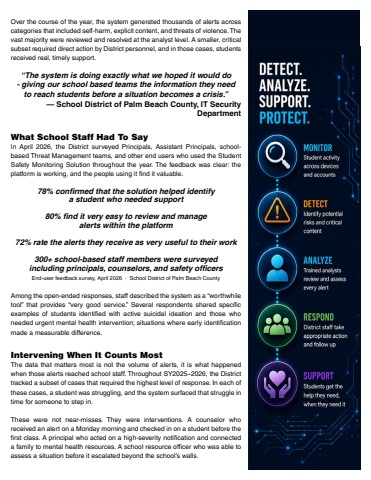
Over the course of the year, the system generated thousands of alerts across categories that included self-harm, explicit content, and threats of violence. The vast majority were reviewed and resolved at the analyst level. A smaller, critical subset required direct action by District personnel, and in those cases, students received real, timely support.%u201cThe system is doing exactly what we hoped it would do - giving our school based teams the information they need to reach students before a situation becomes a crisis.%u201d%u2014 School District of Palm Beach County, IT Security DepartmentWhat School Staff Had To SayIn April 2026, the District surveyed Principals, Assistant Principals, schoolbased Threat Management teams, and other end users who used the Student Safety Monitoring Solution throughout the year. The feedback was clear: the platform is working, and the people using it find it valuable.78% confirmed that the solution helped identifya student who needed support80% find it very easy to review and manage alerts within the platform72% rate the alerts they receive as very useful to their work300+ school-based staff members were surveyed including principals, counselors, and safety officersEnd-user feedback survey, April 2026 %u00b7 School District of Palm Beach CountyAmong the open-ended responses, staff described the system as a %u201cworthwhile tool%u201d that provides %u201cvery good service.%u201d Several respondents shared specific examples of students identified with active suicidal ideation and those who needed urgent mental health intervention; situations where early identification made a measurable difference.Intervening When It Counts MostThe data that matters most is not the volume of alerts, it is what happened when those alerts reached school staff. Throughout SY2025%u20132026, the District tracked a subset of cases that required the highest level of response. In each of these cases, a student was struggling, and the system surfaced that struggle in time for someone to step in.These were not near-misses. They were interventions. A counselor who received an alert on a Monday morning and checked in on a student before the first class. A principal who acted on a high-severity notification and connected a family to mental health resources. A school resource officer who was able to assess a situation before it escalated beyond the school%u2019s walls.


